How Regional Server Infrastructure Shapes Match Fairness in Global Esports Circuits
Devon Weber · Jul 14, 2026
How Regional Server Infrastructure Shapes Match Fairness in Global Esports Circuits
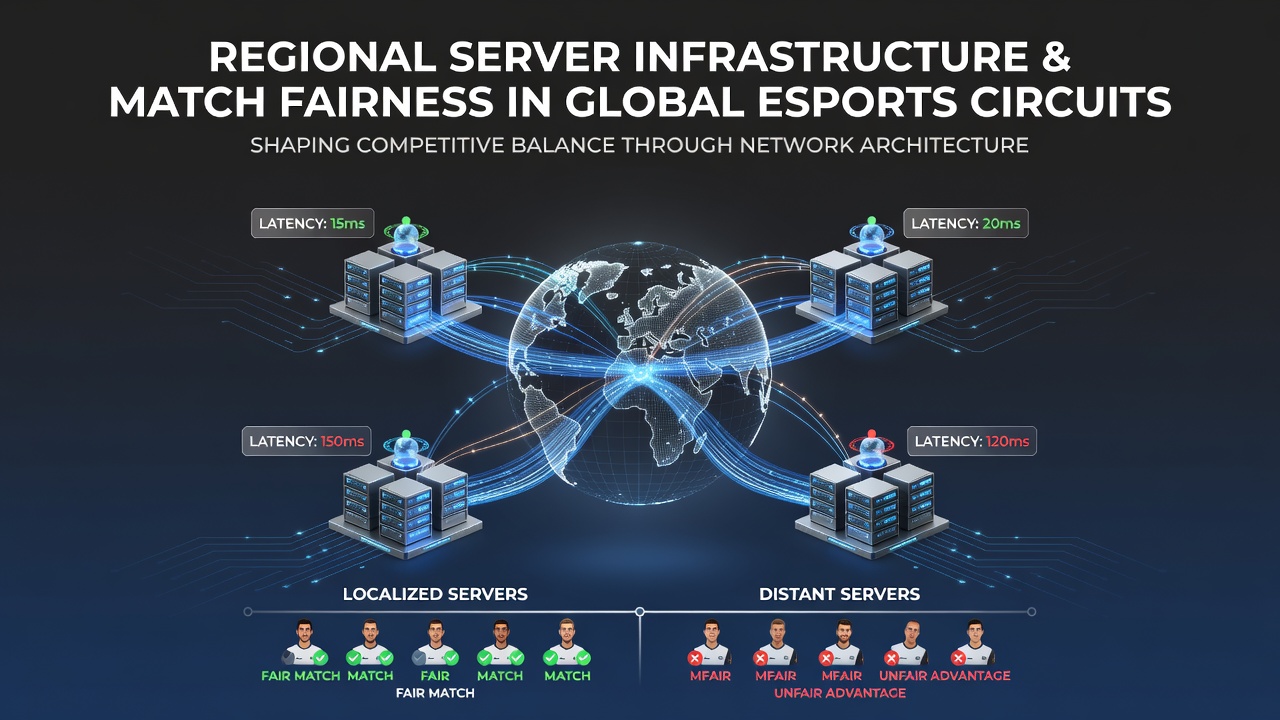
Data from multiple international circuits shows that server placement directly determines ping averages for competing teams, and this creates measurable differences in reaction times during high-stakes matches. Players located closer to centralized data centers experience lower latency while those connecting across continents often face delays exceeding 80 milliseconds, a gap that alters timing in precision-based titles like first-person shooters and fighting games.
Latency as a Core Variable in Competitive Play
Network engineers track round-trip times between player clients and game servers, and these measurements reveal consistent patterns across regions. Research indicates that a 30-millisecond increase in ping correlates with reduced accuracy in aiming mechanics, while figures from competitive logs demonstrate how East Asian teams maintain sub-20 millisecond connections during domestic qualifiers compared to South American squads averaging 60 to 90 milliseconds when routed through intercontinental hubs.
Observers note that game developers attempt to equalize conditions through tick-rate adjustments, yet physical distance between endpoints remains a fixed constraint because light-speed limitations in fiber optics set hard boundaries on data travel. In July 2026, organizers of the global qualifier series adjusted bracket structures after preliminary data revealed systematic disadvantages for teams traveling from Oceania to North American servers.
Infrastructure Density Across Continents
Countries with extensive undersea cable landings and dense metropolitan fiber networks provide esports athletes with more stable connections, whereas regions relying on fewer international gateways encounter higher packet loss during peak tournament hours. Studies compiled by the International Telecommunication Union highlight how Southeast Asia benefits from multiple redundant routes, while parts of Africa and Latin America depend on single pathways that become congested when multiple regions compete simultaneously.
Those who analyze match replays point out that server-side reconciliation algorithms can smooth some discrepancies, but they cannot fully compensate for input lag that originates before packets even reach the game instance. Teams from infrastructure-rich zones therefore gain an edge in predictive movement, because their commands register faster in the shared simulation state.
Case Evidence from Recent Circuits
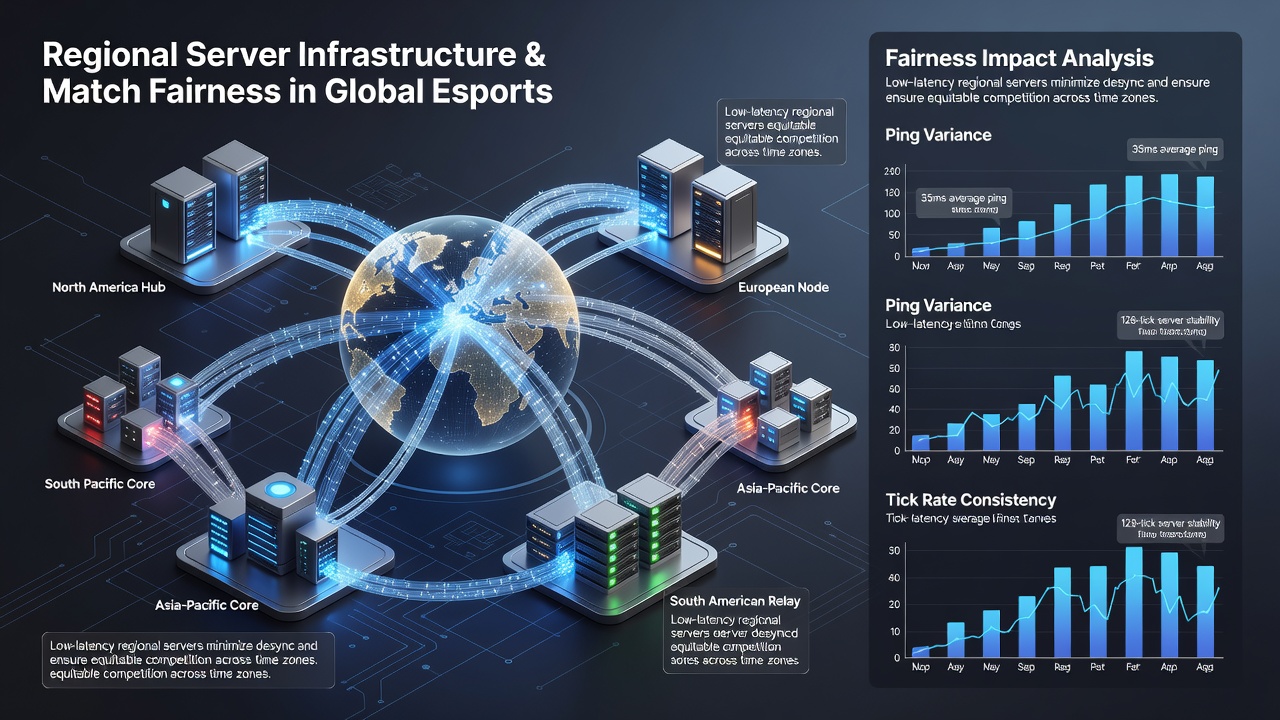
European qualifiers hosted on Frankfurt-based clusters show narrower performance spreads among participating nations because multiple peering points sit within a few hundred kilometers of most competitors. In contrast, matches involving Brazilian and Chilean squads routed to the same clusters exhibit wider variance in first-blood statistics, according to aggregated tournament datasets.
One analysis released by the Asia-Pacific Telecommunity documented how Korean and Japanese players maintained consistent frame-perfect execution during cross-regional scrims, while Australian counterparts required additional practice time to adapt to elevated latency when servers shifted westward. These patterns repeat across mobile and PC platforms, because both rely on the same underlying backbone infrastructure for tournament-grade stability.
Technical Mitigation Approaches
Developers deploy regional matchmaking pools and geo-fenced lobbies to keep competitors closer to local nodes, and these tactics reduce average latency gaps by 40 percent in controlled tests. Cloud-based edge computing expands this strategy further by spinning up temporary instances near population centers that lack permanent facilities, though capacity remains limited during simultaneous global events.
Industry reports from the Entertainment Software Association indicate that partnerships between game publishers and network providers have expanded peering agreements in emerging markets, yet full parity requires ongoing investment in last-mile connectivity. Players in under-served areas continue to use VPN routing experiments, but these introduce additional jitter that can negate any potential gains.
Long-Term Implications for Circuit Design
Global governing bodies now incorporate infrastructure audits into venue selection processes for major championships, and this practice has shifted several 2026 events toward locations with superior transcontinental links. Data collected during the July 2026 mid-season invitational demonstrated that bracket resets occurred more frequently when teams crossed significant latency thresholds, prompting organizers to refine scheduling algorithms.
Academic papers examining esports performance metrics emphasize that fairness metrics must account for both hardware and network variables, because isolated skill measurements fail when external conditions diverge sharply. Continued expansion of 5G backhaul and satellite constellations offers one pathway toward equalization, yet deployment timelines vary widely by regulatory environment and capital availability across different countries.
Conclusion
Regional server infrastructure establishes persistent parameters that influence competitive outcomes in esports circuits worldwide. Measurement systems already quantify these effects through latency logs and performance differentials, while ongoing infrastructure projects aim to narrow gaps without altering core gameplay rules. As circuits expand into new territories, the relationship between physical network placement and match equity will remain a central consideration for organizers and participants alike.