The Unexpected Allure of Peripheral Lore: How Background Item Descriptions and Flavor Text Build Immersive Worlds in Exploration-Heavy Titles
Hugo Vogel · May 22, 2026
The Unexpected Allure of Peripheral Lore: How Background Item Descriptions and Flavor Text Build Immersive Worlds in Exploration-Heavy Titles
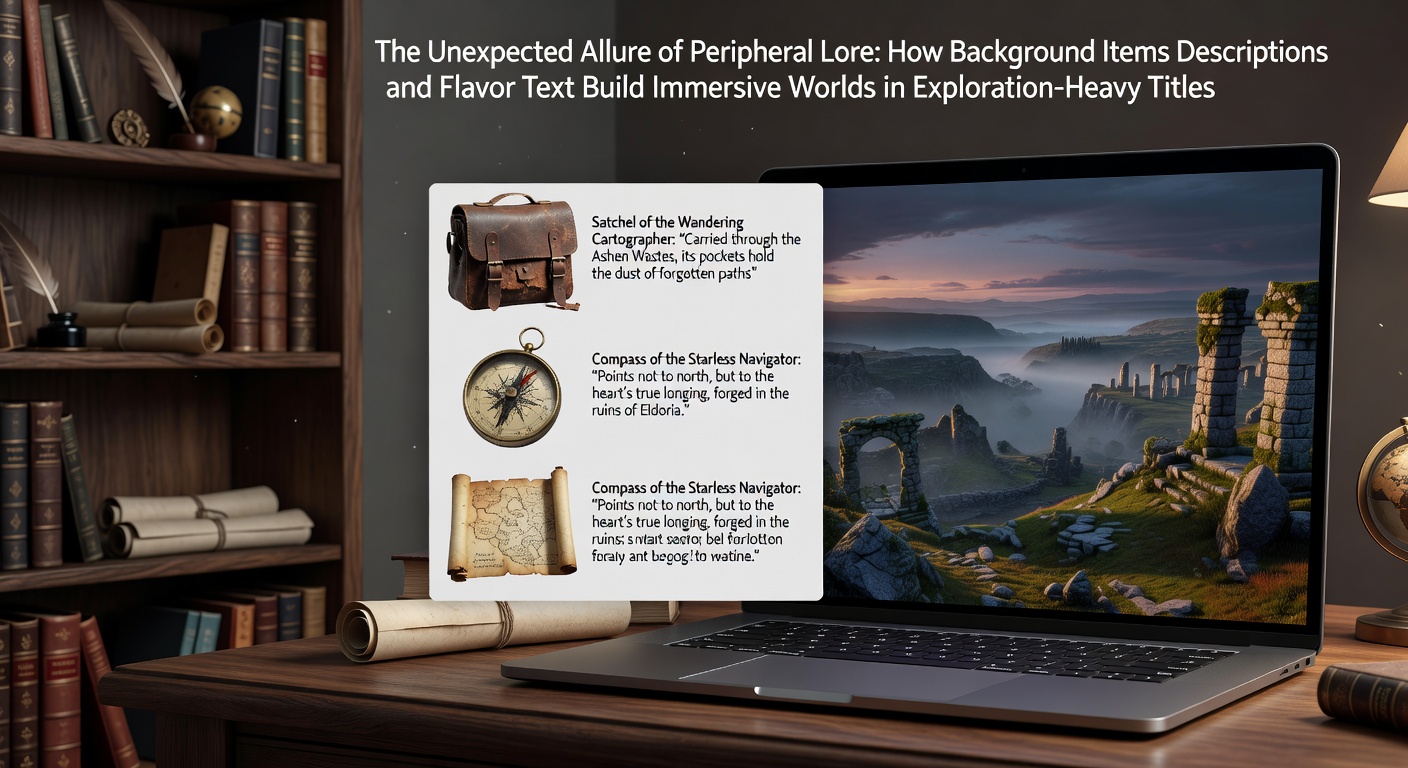
Exploration-heavy titles often rely on more than vast maps and intricate mechanics to draw players in, and peripheral lore delivered through item descriptions plus flavor text plays a central role in that process. These textual elements provide layers of background information that expand the game world without interrupting core gameplay loops, and they allow developers to convey history, culture, and character details in concise yet evocative passages. Observers note that such writing rewards careful examination during exploration, turning routine item collection into moments of discovery that deepen narrative context over time.
Foundations of Peripheral Lore in Game Design
Game developers incorporate flavor text into item descriptions to establish consistent world rules while leaving room for player interpretation, and this approach appears across genres from open-world RPGs to narrative-driven adventures. According to industry reports from the Interactive Software Federation of Europe, detailed textual content in exploration titles contributes to sustained player retention by encouraging repeated engagement with environmental storytelling. Those who study these patterns find that short passages attached to weapons, artifacts, and consumables can reference past events or societal norms, which in turn connects disparate locations into a cohesive whole. Research indicates that this method avoids heavy exposition dumps, instead distributing information across hundreds of individual entries that players encounter naturally during travel and scavenging.
Design teams balance brevity with depth in these texts, since overly long descriptions risk being skipped while sparse ones fail to add meaningful context. Engineers and writers collaborate to embed subtle clues about faction conflicts or environmental changes, and this integration supports the exploration focus by making every corner of the map potentially informative. Data from player behavior analytics shows higher completion rates for side objectives when flavor text ties directly into questlines or hidden areas, creating feedback loops that keep users searching for more details.
Examples Across Major Titles
Several franchises demonstrate effective use of background descriptions to enhance immersion, with series like The Elder Scrolls relying on book excerpts and item notes to outline regional histories without requiring direct dialogue. In these games, an old sword might reference a forgotten battle through a few lines of text, which then informs the player's understanding of nearby ruins or political tensions. Similarly, action-adventure titles such as the Horizon series use machine component descriptions to explain technological decay and tribal customs, allowing explorers to piece together post-apocalyptic events organically. Observers have documented how these elements accumulate, with players often returning to menus to reread entries after new revelations emerge in the main story.
Another case involves soulslike games where cryptic item lore reveals character backstories and world-ending cycles through fragmented accounts. Developers at FromSoftware have refined this technique over multiple releases, resulting in communities that compile and debate the scattered details long after launch. Figures from academic studies on digital narratives reveal that such indirect delivery methods increase perceived depth, as participants report feeling more connected to the environment when they actively uncover these pieces rather than receiving them through cutscenes alone.
Player Interaction and Discovery Mechanics
Players interact with peripheral lore through inventory screens and examination prompts, which encourages slower pacing in fast-moving exploration segments. This interaction pattern lets individuals decide how much attention to devote to each text block, and many choose to read everything while others skim for mechanical stats alone. Studies conducted by North American research institutions on engagement metrics indicate that those who engage deeply with flavor text spend more time in secondary areas, uncovering optional content that expands the overall experience. Yet the texts also serve practical purposes, such as hinting at usage strategies or vulnerabilities in enemies, which blends informational and functional value seamlessly.
Community discussions around these descriptions often surface on forums and wikis, where contributors map connections between seemingly unrelated entries to form larger theories. This player-driven analysis extends the life of exploration titles beyond initial playthroughs, as new patches or expansions sometimes add fresh items with updated lore that references prior events. In May 2026, updates to several long-running series incorporated additional flavor text layers tied to seasonal events, prompting renewed exploration in previously mapped regions according to tracking data from major platforms.
Technical Implementation and Challenges
Implementing peripheral lore requires careful localization efforts, since translations must preserve tone and implication across languages without expanding file sizes significantly. Writers work within character limits that still allow for evocative phrasing, and programmers integrate these strings into dynamic systems that trigger based on player progress or location. Challenges arise when balancing accessibility features like text scaling or audio narration for descriptions, yet solutions continue to evolve through iterative testing. Reports from Canadian gaming associations highlight how inclusive design choices around readable flavor text improve participation rates among diverse audiences in exploration-heavy formats.
Performance considerations also factor in, because loading extensive text databases must occur without affecting frame rates during open traversal. Developers address this through streaming techniques and modular asset management, ensuring that background information remains available on demand. Those who've analyzed engine usage note that these optimizations allow for richer textual content in current-generation titles compared to earlier hardware constraints.
Conclusion
Peripheral lore through item descriptions and flavor text continues to serve as a foundational tool for building depth in exploration-focused games, connecting mechanical systems with narrative threads in efficient ways. As development practices advance, these elements adapt to new platforms and player expectations while maintaining their role in rewarding attentive discovery. Evidence from ongoing industry analyses suggests sustained reliance on such methods to differentiate expansive worlds and encourage thorough engagement across multiple sessions.